
























































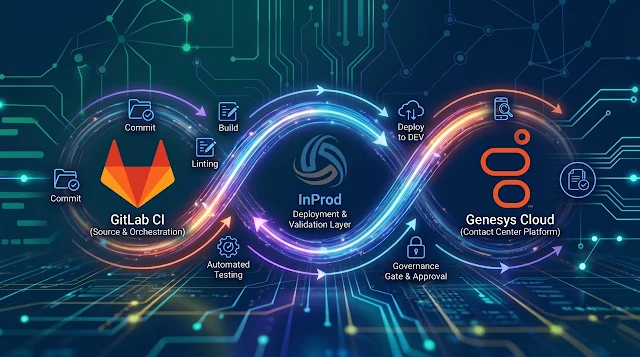
Securing the Contact Center Deployment Pipeline
Even with a strict contact center deployment pipeline in place, configuration drift remains a constant threat. Drift occurs when someone bypasses the automated process and makes a manual change directly in the production environment. This immediately invalidates the source of truth stored in version control.
To combat this, your pipeline should include scheduled validation checks. You can configure a nightly GitLab CI job that compares the actual state of the production environment against the desired state defined in your repository. If the job detects a discrepancy, it alerts the engineering team immediately.

Catching drift early prevents deployment failures. If a pipeline attempts to execute a Genesys Cloud pipeline automation step into an environment that has drifted, the deployment might fail or cause unintended side effects. Regular validation ensures that the pipeline operates on accurate assumptions about the target environment. It acts as an automated safety net for your operations.
Preparing for Rollbacks
Every deployment strategy must account for failure. When a configuration change causes a critical issue in production, the priority is restoring service as quickly as possible. You cannot afford to troubleshoot complex routing logic while customers wait on hold.

A governed pipeline requires engineers to prepare rollback artifacts before the initial deployment. If a deployment involves updating a series of queues and skills, the repository should also contain the exact configuration needed to revert those specific changes.
When an incident occurs, the team executes the pre-approved rollback pipeline. This replaces panic with a predictable, tested process. Preparing these recovery steps before deployment transforms a potential disaster into a minor, easily resolved incident.

Unifying Software and Infrastructure Delivery
Treating contact center configuration as a manual administrative task is no longer sustainable for enterprise operations. The complexity of routing rules, integrations, and operational demands requires a structured engineering approach backed by configuration as code.
Implementing a contact center continuous integration process unifies your customer experience platform with your broader software delivery practices. It eliminates undocumented changes, enforces peer review, and provides a clear audit trail for every deployment. Engineering leaders gain the confidence that their production environments are stable, predictable, and fully recoverable.
Banda Aceh

Kota Langsa

Aceh Selatan

Aceh Tenggara
Bali

Banten
Bengkulu

DI Yogyakarta
Jakarta Pusat
Jambi
Kalimantan Barat
Kalimantan Selatan
Kalimantan Timur
Kalimantan Utara
Kalimantan Tengah

Lampung
Nusa Tenggara Barat
Palu
Pangkal Pinang
Riau
Sumatera Selatan
Sumatera Utara
Sumatera Barat

Kepulauan Bangka Belitung
Kepulauan Riau
Jawa Barat
Jawa Tengah
Jawa Timur































































































Komentar Terbaru