
























































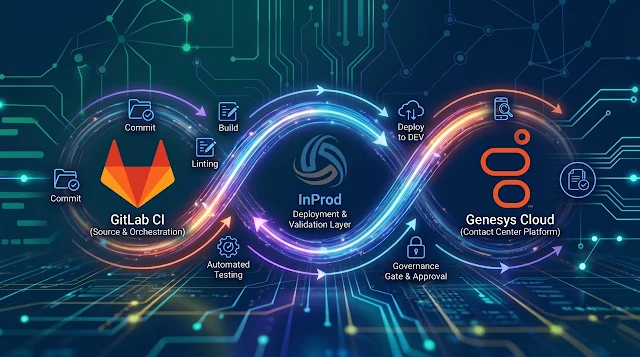
Effective contact center deployment pipeline management requires the exact same engineering discipline that teams apply to their core software products. However, operations teams often still rely on manual changes for updating routing logic, queues, and agent skills. This approach creates immediate operational risks. When engineers log directly into production to tweak a setting, they bypass version control, peer review, and rollback planning. The result is configuration drift, and the production environment becomes unstable over time.
To solve this problem, organizations are adopting configuration as code. By defining infrastructure in text files and storing them in version control, teams can build a true contact center continuous integration process. This shifts the operational model from ad hoc clicking in a user interface to structured software delivery. It provides engineering leaders with the visibility and control needed to scale operations safely. Implementing a formal pipeline ensures that every change is tracked, tested, and approved before reaching customers.

The Problem with Manual Production Changes
Manual configuration scales poorly in complex environments. Consider a scenario where an administrator updates a routing flow to handle a sudden spike in call volume. They make the change directly in the live environment. The change works, but no one documents the exact modifications. A week later, a different administrator deploys a scheduled update to the same routing flow, unknowingly overwriting the emergency fix. Calls begin dropping, and customer satisfaction metrics immediately plummet.

This happens because the system lacks a single source of truth. Without source control, there is no history of what changed, who changed it, or why the change was necessary. Troubleshooting becomes a forensics exercise of guessing who might have logged in to make a change. Rolling back these manual changes often requires administrators to rely on memory or hastily written notes, extending system downtime.
Applying Configuration as Code Principles
The foundation of a reliable Genesys Cloud pipeline automation strategy is configuration as code. This practice involves writing out your queues, skills, routing flows, and integration settings in structured formats like YAML or JSON. You then commit these files to a centralized version control system like Git.

Once your configuration lives in a repository, you unlock the standard tools of software engineering. Engineers can branch the repository to work on complex changes without impacting the current production definitions. Every change becomes a commit with an author and a timestamp. Teams can use pull requests or merge requests to review modifications before they merge into the main branch. A senior engineer can inspect a proposed change and catch a missing dependency before it ever reaches a testing environment.
Banda Aceh

Kota Langsa

Aceh Selatan

Aceh Tenggara
Bali

Banten
Bengkulu

DI Yogyakarta
Jakarta Pusat
Jambi
Kalimantan Barat
Kalimantan Selatan
Kalimantan Timur
Kalimantan Utara
Kalimantan Tengah

Lampung
Nusa Tenggara Barat
Palu
Pangkal Pinang
Riau
Sumatera Selatan
Sumatera Utara
Sumatera Barat

Kepulauan Bangka Belitung
Kepulauan Riau
Jawa Barat
Jawa Tengah
Jawa Timur

































































































Komentar Terbaru