


























































- Configuration: Set MaxKeepAliveRequests to 500+, Set KeepAliveTimeout to 2
- Requirements: Works best on MPM Event.
MPM Event/Worker Optimization
This section details the use and performance considerations that are essential when running Worker based MPMs, including both MPM Event and MPM Worker. These MPMs are considered multi-threaded solutions and some directives behave differently based on the loaded MPM. The information provided in this section is only a portion about Worker based MPMs.
In Worker based MPMs: ServerLimit, ThreadsPerChild, and MaxRequestWorkers are intrinsically linked with each other. It is essential to understand the role of each one and how changing one affects the others. The following directives govern the fine-tuning of the thread handling capabilities of Apache web servers.
MPM Worker and MPM Event
The two modules, MPM Event, and MPM Worker for most intents and purposes operate identically. The difference is apparent in the way each handles KeepAlive requests. The MPM Worker locks threads for the duration of the KeepAlive process and directly affects the number of available threads able to handle new requests. The MPM Event uses a Listener thread for each child. These Listener threads handle standard requests, and KeepAlive requests alike meaning thread locking will not reduce the capacity of the server. Without thread locking, MPM Event is the superior choice but only in Apache 2.4. Before Apache 2.4 the MPM Event was unstable and prone to problems.
ServerLimit
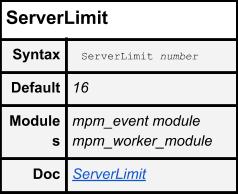
ServerLimit represents the upper limit of children Apache is allowed. The practical usage for ServerLimit is creating a hard ceiling in Apache to protect against input errors with MaxRequestWorkers. The cap prevents spawning vastly more children than a system can handle, resulting in downtime, revenue loss, reputation loss or even data loss.
ServerLimit ties in directly with the thrashing point discussed earlier in this article. The thrashing point is the maximum number of children Apache can run before memory usage tips the scale into perpetual swap. Match the ServerLimit to the calculated thrashing point to safeguard the server.
ThreadsPerChild
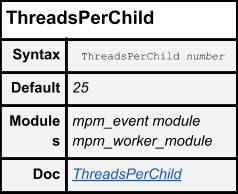
Used to define the limit of threads that each Apache child can manage. Every thread running can handle a single request. The default of 25 works well for most cases and is a fair balance between children and threads.
There is an upper limit on this directive as well, and the limit is controlled by the ThreadLimit directive, which defaults to 64 threads. The adjustments to increase ThreadsPerChild past 64 threads also need to be made to ThreadLimit.
Increasing this value allows each child to handle more requests keeping memory consumption down while allowing a larger MaxRequestWorkers directive. A key benefit of running more threads within each child is shared memory cache access. Threads from one child cannot access caches from another child. Boosting the number of threads per child squeezes out more performance due to this sharing of cache data. The major downside for increased threads per child occurs during child recycling. The capacity of the server is diminished by the number of threads configured for each child when that child process is eventually recycled (graceful restart).




















































Beri Komentar